

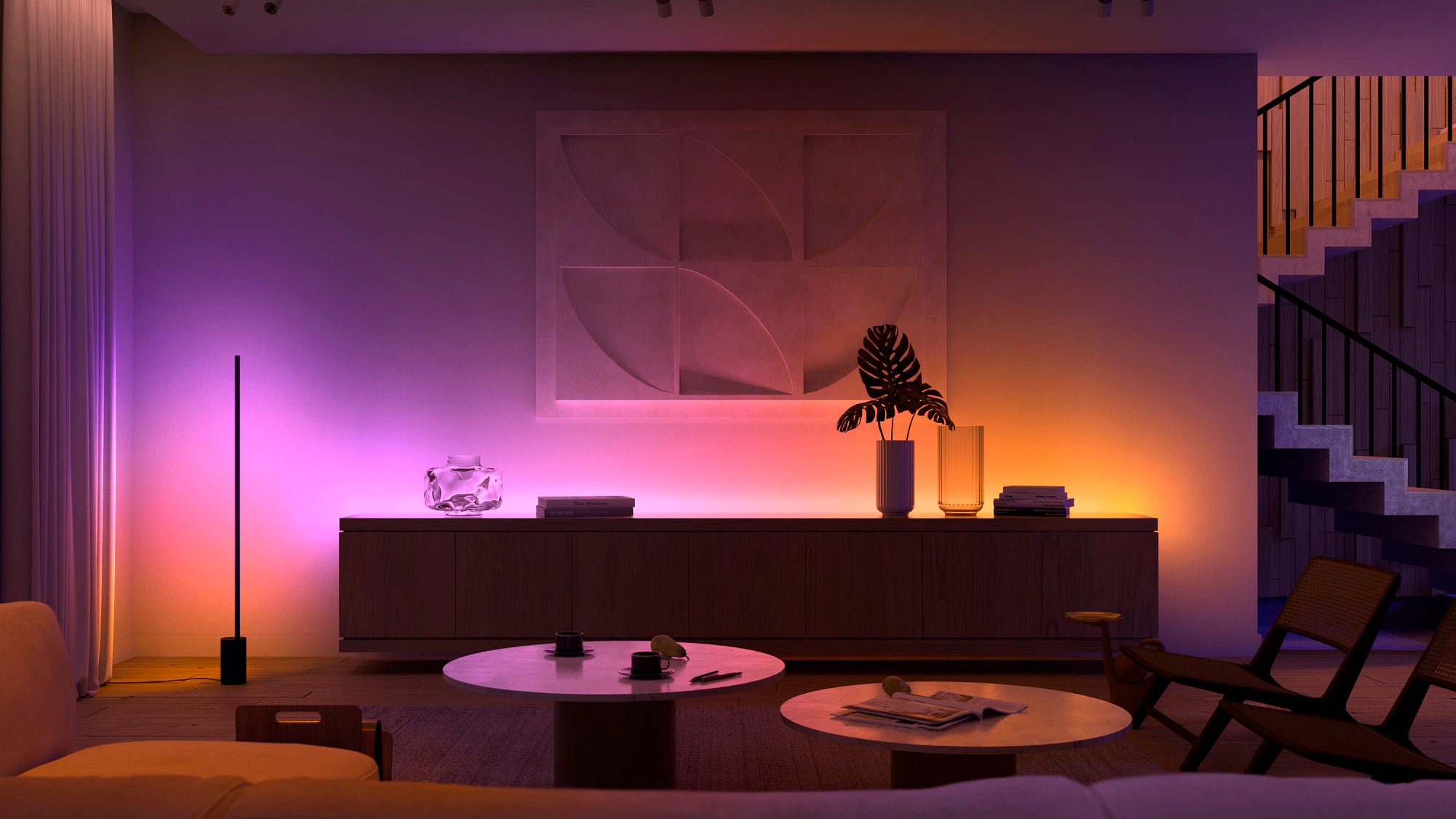
What Philips Hue can do
With Philips Hue smart lights, the Bridge, and the Philips Hue app, you have a smart lighting system that goes far beyond turning on and off your lights.

The Full suite of features
Automate your lights, add smart accessories, sync your lights to the screen. Philips Hue is packed with features that make smart lighting extraordinary.
How Philips Hue works
Philips Hue is built to enrich what you love and how you want to live with smart light — and how it does it is unique. So just how do smart bulbs work? There’s much more to Philips Hue than smart bulbs, so let’s start from the beginning.
With Bridge Zigbee
The Bridge and Bridge Pro are a smart hubs that connect to your router to establish a Zigbee network. Once you install your lights, they can communicate with the Bridge and each other.
Each light is a repeater of the signal, meaning that you can extend the network by adding lights. This is called a mesh network.
By connecting it to the router, the Bridge becomes part of your home’s local area network (LAN). This allows you to control your system even when the internet is down.
Zigbee and Wi-Fi use the same frequency band (2.4 GHz), but Zigbee does not use any Wi-Fi bandwidth to control the lights. So it doesn't matter if you have 1, 10, or 50 lights and accessories — you’re not using additional Wi-Fi bandwidth.
This is especially important if you have lots of lights or if you want to sync your lights to your TV, gaming setup, or music. Wi-Fi lights may lag; Zigbee lights won’t.
Yes! This is one of the greatest advantages of Zigbee vs. Wi-Fi lights. Your lights will still run automations, and you can control them with any switches you have in your home. The app and away-from-home control won’t work.
Bluetooth
If you don’t want a smart hub, you can use Bluetooth. This way, you use your mobile device to communicate directly with the lights.
As you (and your device) move, the network moves with you. This is why there’s a limit as to how far away you can be from your lights.
Yes! Because all our lights are Zigbee-capable, you can add a Bridge to your setup any time. All you need to do is plug a Bridge into your router and add it to your setup. Boom – you'll instantly unlock all the advanced features of a Hue smart home.
If a Hue light is Bluetooth capable, it will have the Bluetooth symbol on the packaging, as well as on the light itself. Outdoor lights and some older lights aren’t compatible with Bluetooth.
Our LED lighting
Beauty and brains. All of our bulbs, lamps, and lighting effects are researched and designed at our headquarters in the Netherlands.
Chromasync™
Professional-grade lighting for your home with precision color matching across all your smart lights. Get deep saturated colors, soft pastels, and shades of white light without any color variation across bulbs, lamps, and luminaires.
White
A soft white light that’s easy on the eyes.
White ambiance
All shades of white light, from warm orange to cool blue.
White and color ambiance
All shades of white light plus full color.
Gradient
Color temperature: 2200–6500 K +16 million colors
Considered RGBWWIC, meaning they can display multiple colors of light simultaneously.
How is Hue different? Hue gradient lights are controlled with groups of LEDs rather than individually, so you always get an even, gradual blend of color.
ColorCast™
Our innovative design of precisely arranged LEDs projects color like no other light.
Full-spectrum daylight
Bring daylight inside with full-spectrum tunable white light. Enjoy the widest range of white tones, from the warmest candle flame hues of amber to the coolest crisp whites of natural blue sky.
Ultra-low dimming
Get the gentlest nightlight with ultra-low dimming. Dim your lights down to just 0.2% of their total brightness.